Why Thailand Is Becoming a Major EV & Smart Mobility Hub in Southeast Asia
Thailand has long been one of Southeast Asia's most important automotive manufacturing centers. Today, the country is entering a new phase of mobility as electric vehicles (EVs), batteries, charging infrastructure, connected technologies and smart mobility solutions become increasingly important.
The transformation is being supported by government policies, new investments, expanding EV production, growing charging infrastructure and the arrival of international automotive and technology companies.
According to Thailand's Board of Investment (BOI), approved investment in the country's EV industry reached more than 137 billion baht across 198 projects as of May 2026. These projects cover electric vehicles, batteries and energy storage systems, critical EV components, charging stations and battery-swapping infrastructure.
At the same time, Thailand's domestic EV market is expanding. The International Energy Agency (IEA) reported that electric-car sales in Thailand increased by approximately 70% in 2025 to around 140,000 vehicles, representing nearly one-quarter of new-car sales.
These developments are helping Thailand strengthen its position as an important destination for companies involved in electric mobility and next-generation transportation.
Thailand's Automotive Industry Is Entering a New Era
Thailand already has a well-established automotive manufacturing ecosystem, with extensive experience in vehicle assembly, automotive components, supply chains and exports.
The growth of EVs is allowing the country to build on this existing industrial base while developing new capabilities in batteries, power electronics, electric drivetrains, charging systems, software and connected mobility.
This is an important distinction.
Thailand's EV opportunity is not limited to selling electric cars. It involves building an integrated ecosystem that includes:
Electric vehicle manufacturing
Battery production
Battery and energy storage systems
EV components
Charging infrastructure
Battery swapping
Smart mobility technologies
Connected vehicles
Intelligent transportation systems
Automotive software and electronics
Fleet electrification
Sustainable transportation solutions
The country's investment strategy is increasingly focused on this broader ecosystem.
Growing EV Investment in Thailand
One of the clearest indicators of Thailand's growing EV sector is the amount of investment entering the industry.
Thailand's BOI reported that, as of May 2026, 198 EV-related projects worth more than 137 billion baht had received investment promotion. The investments span several parts of the EV value chain.
According to the BOI data, the investment includes:
BEV manufacturing
HEV manufacturing
PHEV manufacturing
Electric buses and motorcycles
Battery and energy storage systems
Key EV components
Charging stations
Battery-swapping infrastructure
The battery and energy-storage segment alone accounted for approximately 33.5 billion baht across 57 projects, while key EV components represented around 12.5 billion baht across 49 projects. Charging and battery-swapping projects represented around 9.8 billion baht across 42 projects.
This investment indicates that Thailand's EV development is moving beyond vehicle assembly toward a wider industrial ecosystem.
EV Manufacturing Is Expanding
Thailand's existing automotive supply chain provides an important foundation for EV manufacturing.
Several international manufacturers have established or expanded EV production activities in the country. The BOI reported that manufacturers supported through Thailand's EV policies have started BEV production, with companies including Mercedes-Benz, Great Wall Motor, SAIC Motor-CP, BYD, AION, Changan, EV Primus and others.
The BOI also reported that BMW, Hyundai Mobility and OMODA & JAECOO were among companies starting BEV production in Thailand in 2026.
This expansion is significant because local manufacturing can create opportunities throughout the supply chain.
As more EV manufacturers establish production in Thailand, opportunities can emerge for suppliers of:
Batteries
Electric motors
Battery management systems
Power electronics
Charging equipment
Automotive electronics
Software
Thermal management systems
Lightweight materials
Safety technologies
For companies looking to enter Southeast Asia's EV market, this growing industrial ecosystem makes Thailand an increasingly relevant market to watch.
Government Policies Are Supporting the EV Transition
Government policy has played an important role in Thailand's EV development.
Thailand introduced EV support measures designed to increase EV adoption while encouraging manufacturers to establish production within the country.
The EV 3.5 scheme, which covers the 2024–2027 period, provides support for EV manufacturing and consumer adoption while encouraging the development of the wider EV ecosystem.
Thailand has also established the broader 30@30 ambition, which aims for zero-emission vehicles to account for at least 30% of domestic vehicle production by 2030.
More recently, Thailand has adjusted its EV incentive framework to reflect changing market conditions and encourage stronger local production and supply-chain development.
These policies demonstrate that Thailand's EV strategy is not focused exclusively on short-term vehicle sales. Manufacturing, investment, local supply chains and technology development are also important parts of the country's approach.
EV Charging Infrastructure Is Growing
A successful EV market requires more than electric vehicles. Drivers need reliable and accessible charging infrastructure.
Thailand is therefore seeing investment in charging networks alongside vehicle manufacturing.
As of May 2026, BOI-supported charging and battery-swapping projects represented approximately 9.8 billion baht across 42 projects, with more than 22,900 charging connectors planned, including more than 10,000 fast-charging connectors.
The expansion of charging infrastructure can support several areas of the mobility ecosystem:
Public charging
Public charging networks are important for EV owners travelling between cities and within urban areas.
Workplace charging
Companies can install charging facilities for employees and business fleets.
Commercial and fleet charging
Delivery fleets, taxis, logistics companies and other commercial operators can require dedicated charging infrastructure.
Fast charging
Fast-charging technology can reduce charging time and make EVs more practical for longer-distance travel.
The growth of charging infrastructure also creates opportunities for companies specializing in charging hardware, software, energy management, payment systems and charging-network operations.
Thailand's EV Market Is Growing
The country's EV manufacturing ambitions are being supported by increasing consumer adoption.
According to the IEA, Thailand's electric-car sales increased by approximately 70% in 2025 compared with 2024, reaching around 140,000 vehicles. Electric cars accounted for nearly one-quarter of new-car sales in the country.
The IEA also reported that Thai-made electric cars represented approximately 20% of the country's electric-car market in 2025, compared with around 5% in 2024.
This shift is important because it suggests that Thailand is developing not only as an EV import market but also as a production location.
The combination of local production and consumer adoption can create a stronger foundation for the country's wider EV ecosystem.
From Electric Vehicles to Smart Mobility
The next stage of Thailand's mobility transformation goes beyond electrification.
Smart mobility combines electric transportation with technologies such as:
Connected vehicles
Artificial intelligence
Data analytics
Intelligent traffic management
Autonomous driving technologies
Digital fleet management
Mobility-as-a-Service
Smart charging
Energy management
Advanced driver assistance systems
Shared mobility
Thailand's BOI has described the transition in terms of Smart and Green Mobility, highlighting the growing importance of technologies associated with autonomous, connected, electric and shared mobility.
This means the opportunity is expanding from traditional automotive manufacturing into technology and digital mobility.
For technology companies, startups, investors and mobility operators, Thailand can therefore provide opportunities beyond the production of EVs themselves.
Why Southeast Asia Matters
Thailand's position becomes even more significant when viewed within the broader Southeast Asian market.
The region is experiencing rapid EV growth. The IEA reported that electric-car sales across Southeast Asia more than doubled in 2025, reaching more than half a million vehicles. Electric cars represented close to one in five cars sold across the region.
Thailand is one of the countries contributing to this regional transformation.
Its established automotive manufacturing industry, geographical position, supply-chain capabilities and investment policies make it an important location for businesses looking to participate in Southeast Asia's mobility transition.
Thailand can also serve as a meeting point between automotive manufacturers, suppliers, charging companies, technology providers, investors and mobility stakeholders from across the region.
Opportunities for EV and Smart Mobility Companies
The development of Thailand's EV ecosystem creates opportunities for businesses across multiple sectors.
Automotive manufacturers
Vehicle manufacturers can explore production, partnerships and market opportunities within Thailand and the wider ASEAN region.
Battery companies
The growth of EV manufacturing increases demand for battery cells, modules, packs, battery management systems and energy-storage technologies.
Charging companies
The expansion of the EV market creates demand for charging hardware, network management platforms, payment solutions and fast-charging technologies.
Technology companies
Connected vehicles, AI, autonomous driving, data platforms and intelligent transportation systems are becoming increasingly relevant to the future of mobility.
Fleet operators
Electrification can create opportunities for logistics companies, delivery fleets, public transportation operators and corporate mobility providers.
Investors
The growth of the EV ecosystem creates opportunities across manufacturing, infrastructure, technology, energy and mobility services.
Why Bangkok Is an Important Meeting Point for the EV Industry
As Thailand's major business and transportation center, Bangkok provides a natural meeting point for companies involved in the country's mobility transformation.
Industry conferences and exhibitions can play an important role by bringing together manufacturers, investors, policymakers, technology providers, startups, charging companies and mobility professionals.
For businesses entering or expanding in Southeast Asia, these events provide opportunities to:
Meet potential business partners
Discover emerging technologies
Explore investment opportunities
Connect with suppliers
Understand market trends
Build regional partnerships
Meet investors and decision-makers
Showcase new products and solutions
Learn about EV and smart mobility developments
This is particularly relevant as Thailand's EV ecosystem becomes more interconnected with the wider Southeast Asian market.
EV Smart Mobility Conference 2027 – Bangkok, Thailand
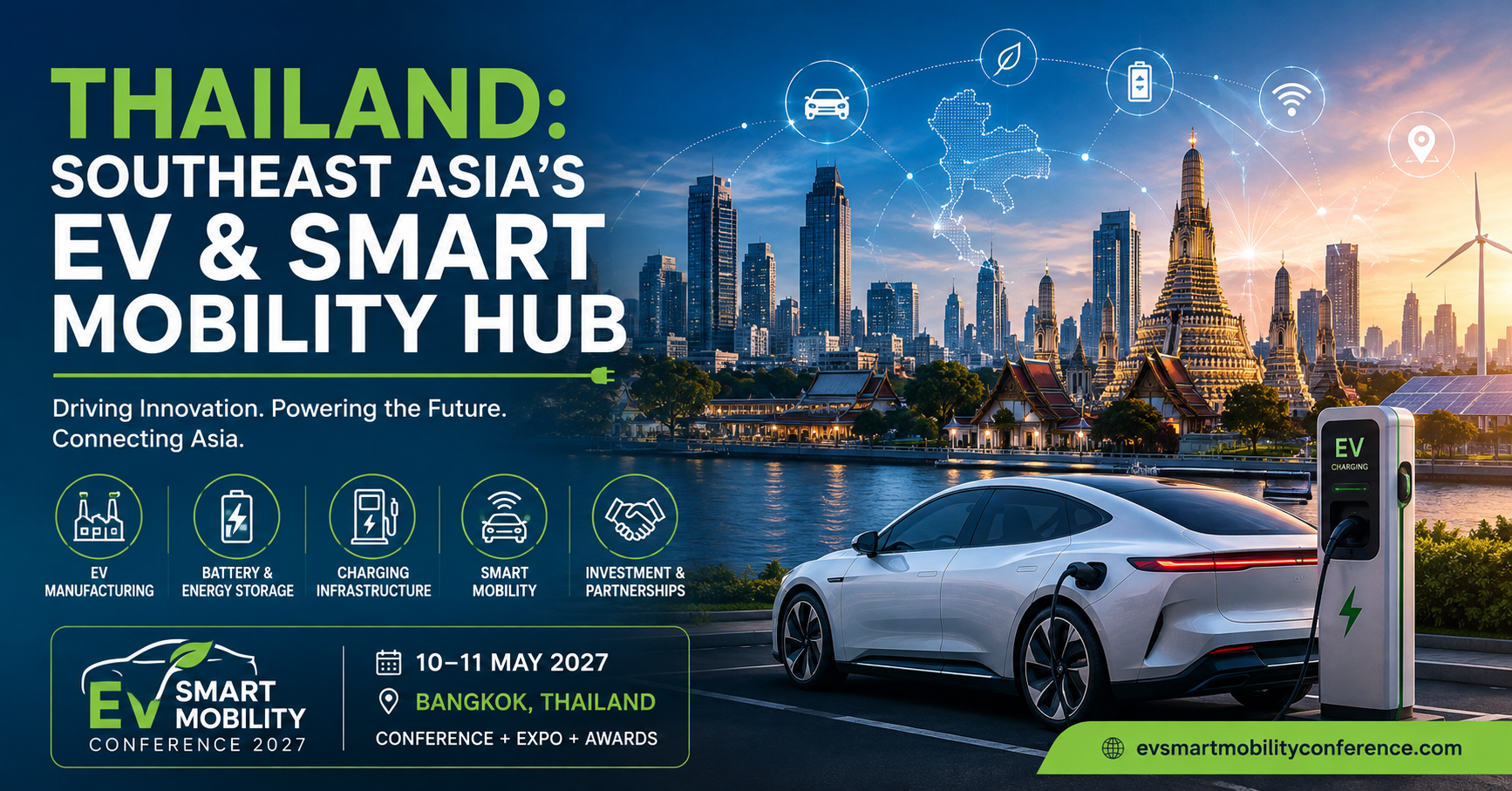
Against this rapidly developing background, the EV Smart Mobility Conference 2027 will bring together professionals from the electric vehicle and smart mobility ecosystem in Bangkok.
The event is scheduled for 10–11 May 2027 in Bangkok, Thailand, combining a Conference + Expo + Awards format.
The event is designed to provide a platform for discussions, business networking, technology discovery and industry engagement across the EV and smart mobility ecosystem.
Participants can explore topics covering areas such as electric vehicles, batteries, charging infrastructure, smart mobility, connected transportation, sustainable mobility, automotive technology and the future of transportation.
For manufacturers, technology companies, charging providers, investors, startups, fleet operators and mobility professionals, the event provides an opportunity to connect with stakeholders participating in the transformation of Southeast Asia's transportation industry.
What the Future Could Look Like
Thailand's EV transformation is still developing.
The next several years are likely to be important for manufacturers, technology companies, charging providers, investors and policymakers as the country continues building its electric and smart mobility ecosystem.
The direction is already visible: increasing EV adoption, expanding manufacturing, growing investment, more charging infrastructure and greater attention to connected and intelligent transportation.
The challenge will be turning this momentum into a competitive, sustainable and integrated mobility ecosystem.
Thailand's existing automotive capabilities give it an important starting point. Continued investment in batteries, charging, software, electronics, energy systems, workforce development and local supply chains will help determine how the ecosystem develops.
Conclusion
Thailand is becoming an increasingly important EV and smart mobility hub in Southeast Asia because several factors are developing simultaneously.
The country has an established automotive manufacturing base, growing EV demand, substantial investment across the EV supply chain, expanding charging infrastructure and government policies designed to support the transition.
With more than 137 billion baht in BOI-approved EV investment across 198 projects as of May 2026, Thailand's EV transformation has moved well beyond an early-stage market experiment.
The country's future opportunity is also broader than electric cars. Batteries, charging infrastructure, connected vehicles, digital platforms, smart transportation and sustainable mobility are all becoming part of the emerging ecosystem.
As Southeast Asia's electric mobility market continues to expand, Thailand will remain an important market for companies looking to understand and participate in the region's transportation transformation.
For industry professionals, investors, manufacturers, technology providers and mobility innovators, 2027 will be an important year to watch Thailand's EV and smart mobility development.
And for those looking to connect with the industry in person, the EV Smart Mobility Conference 2027 in Bangkok on 10–11 May 2027 offers a dedicated platform to meet the people, technologies and businesses shaping the next generation of mobility.
Frequently Asked Questions
Is Thailand becoming an EV hub in Southeast Asia?
Thailand is developing as an important EV manufacturing and market hub in Southeast Asia. Its automotive manufacturing base, growing EV sales, investment in batteries and components, charging infrastructure and government support are contributing to this development.
How much has Thailand invested in the EV industry?
Thailand's Board of Investment reported more than 137 billion baht in approved EV-related investment across 198 projects as of May 2026. The projects cover vehicles, batteries, critical components, charging stations and battery-swapping infrastructure.
How fast is the EV market growing in Thailand?
The IEA reported that electric-car sales in Thailand increased by approximately 70% in 2025 to around 140,000 vehicles, representing nearly one-quarter of new-car sales.
Why is Thailand attractive for EV manufacturers?
Thailand already has an established automotive manufacturing and supplier ecosystem. Government investment incentives and EV policies are also designed to encourage vehicle production, batteries, components and charging infrastructure.
What is smart mobility?
Smart mobility refers to the use of technologies and new transportation models to make mobility more connected, efficient and sustainable. It can include electric vehicles, connected vehicles, intelligent traffic systems, digital fleet management, smart charging, autonomous technologies and shared mobility.
When is the EV Smart Mobility Conference 2027?
The EV Smart Mobility Conference 2027 is scheduled for 10–11 May 2027 in Bangkok, Thailand. The event combines a Conference, Expo and Awards focused on electric vehicles and smart mobility.
Who should attend an EV and smart mobility conference in Thailand?
Automotive manufacturers, EV startups, battery companies, charging providers, fleet operators, investors, policymakers, technology companies, mobility professionals and other stakeholders involved in the electric and smart mobility ecosystem can benefit from participating.