
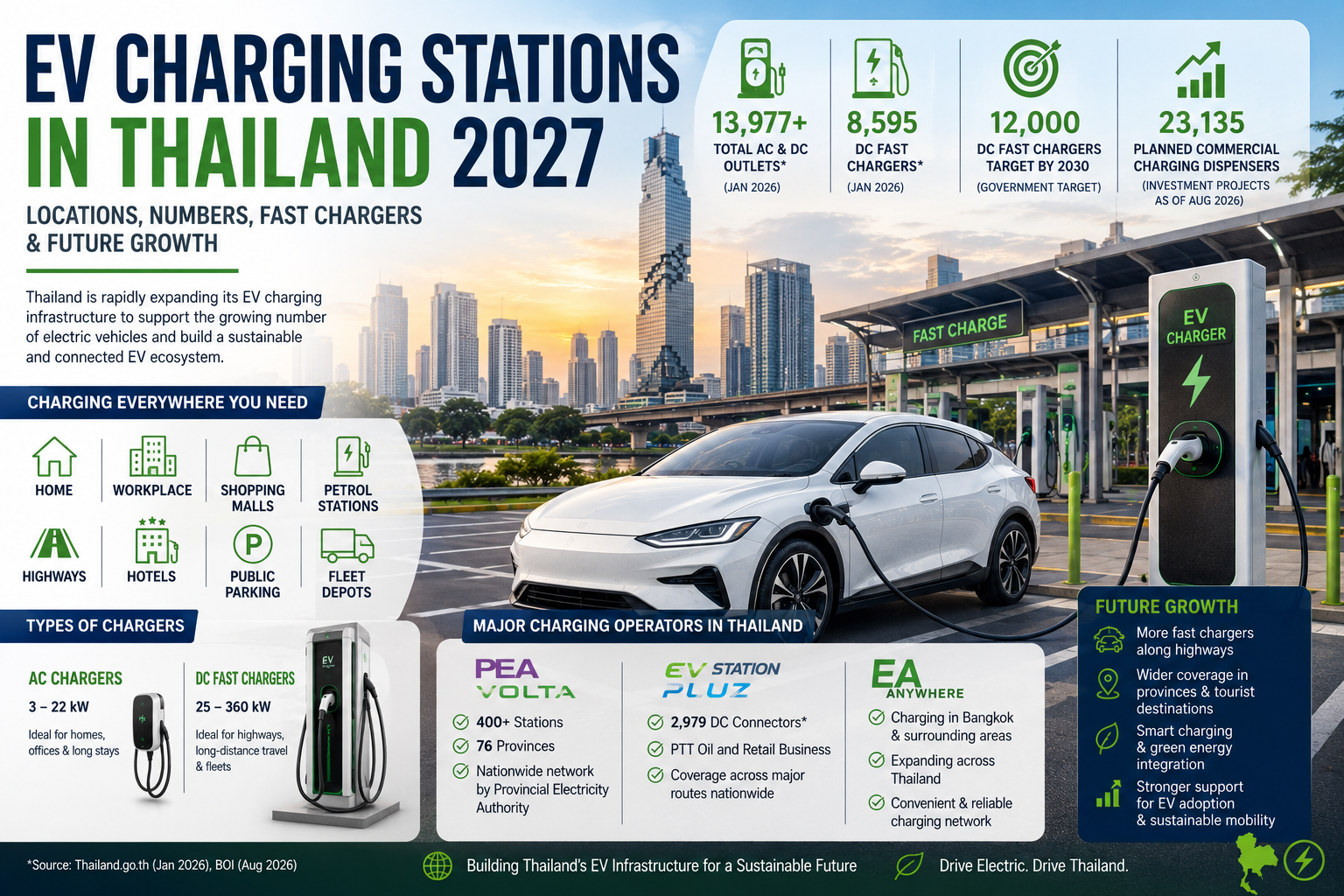
EV Charging Stations in Thailand 2027: Locations, Numbers, Fast Chargers & Future Growth
Thailand's electric vehicle market is growing rapidly, and the country's charging infrastructure is developing alongside it.
As more battery electric vehicles enter the market, drivers need reliable access to charging at homes, workplaces, shopping centres, petrol stations, hotels, highways, fleet depots and public parking facilities.
The charging network is therefore becoming one of the most important parts of Thailand's wider EV transition.
The latest government figures show that Thailand had approximately 8,595 DC charging outlets and 5,382 AC charging outlets as of January 2026. The government is targeting 12,000 DC fast-charging points by 2030.
At the same time, investment-promoted charging projects were planning 23,135 commercial charging dispensers nationwide, including 10,249 DC fast-charging outlets, as of 31 August 2026. The Board of Investment said the planned DC fast chargers already represented about 85% of Thailand's nationwide 2030 target.
These numbers show why EV charging infrastructure will be an important topic throughout 2027.
This guide explains where EV charging stations are located, how many chargers Thailand has, the difference between AC and DC charging, major charging networks, highway charging and what the future could look like.
EV Charging Stations in Thailand: 2027 Overview
Thailand's charging infrastructure consists of several different types of charging locations.
Public charging stations
These are available to EV drivers at locations such as:
Shopping malls
Petrol stations
Hotels
Office buildings
Public car parks
Tourist destinations
Transport hubs
Highway charging
Fast chargers are increasingly being deployed along major roads to support intercity travel.
Workplace charging
Companies are installing chargers for employees and corporate fleets.
Residential charging
Many EV owners charge at home, particularly when they have access to dedicated parking.
Fleet charging
Logistics companies, taxis, buses and commercial fleets require dedicated charging infrastructure.
This combination means that the number of charging stations and the number of charging outlets or dispensers are not necessarily the same thing.
That distinction is important when comparing Thailand's charging statistics.
How Many EV Charging Stations Are There in Thailand?
There is no single number that perfectly describes Thailand's entire charging ecosystem because different sources count different things, including stations, connectors, outlets and investment-promoted chargers.
Thailand's EV Association (EVAT) maintains a dedicated statistical database for Thailand's EV charging-station numbers and publishes historical charging-infrastructure information.
A separate government source reported that, as of January 2026, Thailand had approximately:
8,595 DC charging outlets
5,382 AC charging outlets
This gives a combined total of roughly 13,977 AC and DC charging outlets at that point in time.
However, this should not be confused with the number of physical charging locations.
A single station can have multiple charging outlets.
Thailand's 2030 Fast-Charging Target
Thailand is targeting 12,000 DC fast-charging points by 2030.
The government has identified charging infrastructure as an important requirement for supporting the growth of EV adoption and long-distance travel.
The BOI's August 2026 figures provide another indication of the pace of investment.
Investment-promoted charging projects were planning:
23,135 commercial charging dispensers
including:
10,249 DC fast-charging outlets.
The BOI said these planned DC chargers represented approximately 85% of the country's 2030 target of 12,000 fast-charging DC units.
This does not mean that all 10,249 chargers were already operating. They are chargers associated with investment-promoted projects.
For SEO and informational accuracy, it is important to distinguish planned/project numbers from chargers already in operation.
DC Fast Chargers vs AC Chargers in Thailand
Understanding the difference between AC and DC charging is important when researching Thailand's charging infrastructure.
AC Charging
AC charging is commonly used for:
Homes
Offices
Hotels
Condominiums
Shopping centres
Long-duration parking
AC charging is generally suitable when the vehicle will remain parked for a longer period.
DC Fast Charging
DC charging is designed for situations where drivers need to recharge more quickly.
Fast chargers are particularly important for:
Highways
Long-distance travel
Taxi fleets
Commercial vehicles
Delivery fleets
Busy urban locations
Petrol-station charging hubs
Thailand's PEA VOLTA network, for example, includes DC CCS Combo II chargers ranging from 25 kW and 50 kW to 120 kW, 300 kW and 360 kW, alongside AC and CHAdeMO options.
As EV battery capacities increase, high-power DC charging is likely to become increasingly important.
EV Charging Stations in Bangkok
Bangkok is one of the most important markets for EV charging in Thailand.
The concentration of EV users, businesses, shopping centres, offices and residential developments creates significant charging demand.
The city is also an important starting point for journeys to other parts of the country.
Charging infrastructure in Bangkok can be found across locations such as:
Shopping malls
Office complexes
Hotels
Petrol stations
Residential buildings
Public parking
EV dealerships
Commercial properties
PEA VOLTA operates a network connecting Bangkok with major routes throughout Thailand. Its network covers routes heading north, south, east, west and northeast.
Another example is EA Anywhere, which operates charging infrastructure in Bangkok, surrounding areas and other parts of Thailand.
EV Charging Stations Along Thailand's Highways
Highway charging will be particularly important as EV ownership expands.
Drivers travelling between Bangkok and major cities need access to chargers without making significant detours.
PEA VOLTA specifically positions its charging network around major routes and tourist destinations, with fast-charging services designed to support travel throughout Thailand.
The government has also discussed expanding charging infrastructure in remote areas where private investment may not yet be sufficient.
Thailand's stated objective includes improving charging coverage so that stations are available approximately every 50–100 kilometres in areas requiring additional coverage.
This will be important for making EV travel practical beyond Bangkok and the country's largest cities.
EV Charging Across Thailand's Provinces
Thailand's EV charging network is becoming increasingly national rather than being concentrated exclusively in Bangkok.
PEA VOLTA is one example.
PEA currently reports more than 400 PEA VOLTA charging stations covering 76 provinces.
PEA says its network supports EV travel across major routes and provides charging infrastructure in urban areas, interprovincial routes and tourist destinations.
This provincial expansion matters because EV adoption cannot scale nationally if drivers remain dependent on charging infrastructure in Bangkok alone.
Major EV Charging Operators in Thailand
Thailand's charging ecosystem includes electricity utilities, energy companies, automotive companies and independent charging operators.
Some important networks include the following.
PEA VOLTA
PEA VOLTA is operated by the Provincial Electricity Authority.
The network currently has more than 400 stations covering 76 provinces, according to PEA's current information.
PEA VOLTA provides charging through its digital platform, allowing users to find stations, check availability and manage charging.
Its network is particularly relevant for intercity travel.
EV Station PluZ
EV Station PluZ is operated by PTT Oil and Retail Business (OR).
OR reports that its PTT Station network includes EV chargers under the EV Station PluZ brand and that it plans to expand coverage across major routes nationwide.
As of June 2026, OR reported 2,979 DC connectors in its EV charging network.
This makes petrol-station-based charging an important component of Thailand's transition from conventional fuel infrastructure toward broader energy and mobility services.
EA Anywhere
EA Anywhere provides EV charging services for BEVs and PHEVs.
The company operates charging infrastructure primarily in Bangkok while also providing coverage in surrounding areas and other parts of Thailand.
Its network is another example of private-sector participation in Thailand's charging ecosystem.
Where Will EV Chargers Be Located in 2027?
The charging network is likely to become more diverse.
1. Shopping Malls
Shopping centres are attractive charging locations because vehicles can remain parked while customers shop.
2. Petrol Stations
Existing fuel stations have established locations, road access and customer facilities, making them suitable for EV charging.
3. Highways
Fast-charging hubs will support long-distance EV travel.
4. Hotels
Hotels can provide overnight AC charging and destination charging.
5. Offices
Workplace charging can support employees who commute by EV.
6. Condominiums
As more urban residents purchase EVs, residential charging infrastructure will become increasingly important.
7. Tourist Destinations
Thailand's tourism industry creates another potential demand centre for EV charging.
8. Logistics Hubs
Electric delivery vehicles and commercial fleets require high-utilisation charging facilities.
EV Charging for Fleets in Thailand
Fleet electrification is different from private-car charging.
A fleet operator may need dozens or hundreds of vehicles to charge at predictable times.
Examples include:
Delivery vans
Taxis
Ride-hailing fleets
Electric buses
Logistics trucks
Corporate vehicles
Airport transport
Municipal fleets
For these users, charging management can be just as important as the physical charger.
Fleet operators may need:
Load management
Charging schedules
Energy monitoring
Fleet software
Payment management
Route planning
Depot charging
High-power charging
PEA's VOLTA platform also provides services aimed at fleet management and business users.
Smart EV Charging in Thailand
The future of EV charging is not only about installing more chargers.
It is also about making charging smarter.
Smart charging can involve:
Automated charging schedules
Electricity-price optimisation
Load balancing
Remote monitoring
Mobile applications
Digital payments
Charger availability information
Fleet management
Vehicle-to-grid technologies
PEA VOLTA already provides digital functions for locating stations, checking charger status and managing charging through its platform.
As the number of EVs increases, digital management will become increasingly important for preventing congestion and managing electricity demand.
EV Charging and Thailand's Electricity Grid
Large-scale EV adoption creates a new electricity-demand challenge.
Charging several vehicles simultaneously can create significant local demand, especially at:
Highway charging hubs
Fleet depots
Bus terminals
Shopping centres
Industrial areas
This makes energy management an important part of EV infrastructure.
Future charging projects may increasingly combine:
EV chargers + solar power + battery storage + smart energy management
Thailand's government is already linking EV development with its broader energy transition, including renewable energy and battery technologies.
EV Charging and Renewable Energy
Charging an EV does not automatically mean that all of the electricity comes from renewable energy.
However, charging infrastructure can increasingly be integrated with renewable-energy systems.
Potential applications include:
Solar-powered charging
Solar rooftops at charging stations
Battery storage
Energy-management systems
Off-peak charging
Distributed energy resources
PTT OR, for example, has been installing solar rooftops at PTT Stations as part of its broader energy-transition strategy.
This creates an opportunity to develop charging stations into broader energy and mobility hubs.
EV Charging Investment in Thailand
Charging infrastructure is attracting significant investment.
The BOI reported that investment-promoted projects were planning 23,135 commercial charging dispensers, including 10,249 DC fast-charging outlets, as of August 2026.
This investment can create opportunities for:
Charging-station operators
Hardware manufacturers
Software companies
Energy companies
Real-estate developers
Petrol-station operators
Shopping malls
Fleet companies
Renewable-energy businesses
Battery-storage companies
The charging business therefore extends beyond selling electricity.
Opportunities for Businesses in EV Charging
Thailand's charging expansion creates several potential business models.
Charging-as-a-Service
Businesses can provide charging infrastructure to commercial property owners.
Fleet Charging
Operators can design dedicated charging systems for corporate and logistics fleets.
Charging Software
Software can manage:
Payments
Users
Chargers
Electricity consumption
Fleet schedules
Maintenance
Charging Hardware
There is growing demand for:
AC chargers
DC fast chargers
Charging cables
Power electronics
Energy-management equipment
Property-Based Charging
Shopping malls, hotels, offices and residential developments can use charging as an additional service.
Energy + Charging
Solar and battery storage can be integrated with charging infrastructure.
Battery Swapping in Thailand
Charging is not the only solution being considered.
Battery swapping can be particularly relevant for:
Electric motorcycles
Delivery fleets
Commercial vehicles
High-utilisation applications
Thailand's government has also promoted investment in battery-swapping stations alongside EV charging infrastructure.
Battery swapping can reduce vehicle downtime in applications where charging time is particularly important.
For passenger cars, however, conventional charging infrastructure remains the dominant model.
EV Charging Infrastructure and Electric Motorcycles
Thailand has a large motorcycle market, making electric two-wheelers another potential charging segment.
Charging requirements for electric motorcycles can differ considerably from passenger cars.
Potential solutions include:
Home charging
Workplace charging
Public charging
Battery swapping
Fleet charging
The development of charging and swapping infrastructure could therefore influence how quickly electric motorcycles are adopted.
Challenges Facing Thailand's EV Charging Network
Despite rapid infrastructure growth, several challenges remain.
Uneven geographic distribution
Bangkok and major urban areas can attract investment more easily than remote regions.
Charger utilisation
A charger may be technically available but economically difficult to operate if utilisation remains low.
Grid capacity
Large charging hubs can require significant electrical capacity.
Interoperability
Drivers benefit when different charging networks can work together.
Payment systems
Multiple apps and payment systems can create friction for users.
Maintenance
Chargers need reliable uptime and rapid repair services.
Land availability
High-demand locations can be expensive.
Business economics
Charging operators must balance electricity costs, infrastructure investment, maintenance and utilisation.
These challenges will influence the pace and location of infrastructure deployment through 2027 and beyond.
What Will EV Charging in Thailand Look Like in 2027?
Several trends are likely to shape the market.
More DC fast chargers
Thailand is moving toward its 2030 target of 12,000 DC fast-charging points.
More highway charging
Intercity routes will require additional fast-charging capacity.
More provincial coverage
Networks are expanding beyond Bangkok into other provinces.
Larger charging hubs
High-traffic locations may increasingly feature multiple high-power chargers.
More fleet charging
Electric buses, delivery vehicles and commercial fleets will create specialised charging demand.
Greater software integration
Charging apps and network platforms will increasingly manage payments, reservations, availability and fleet operations.
More energy integration
Solar, battery storage and smart energy management could increasingly be combined with charging infrastructure.
EV Charging Stations in Bangkok vs Other Parts of Thailand
Area | Main charging demand | Likely infrastructure |
|---|---|---|
Bangkok | Private cars, commuters, businesses | AC + DC fast charging |
Greater Bangkok | Commuters and residential EVs | Home, workplace and public charging |
Major highways | Long-distance EV travel | DC fast charging |
Tourist destinations | Visitors and rental vehicles | Destination + DC charging |
Provincial cities | Local EV ownership | AC + DC |
Industrial zones | Employees and commercial fleets | Workplace + fleet charging |
Logistics hubs | Delivery and commercial vehicles | High-power fleet charging |
Remote areas | Intercity travel | Fast-charging corridors |
This geographic diversification will be important as Thailand moves from early EV adoption toward a larger national EV fleet.
Thailand EV Charging Infrastructure: Key Numbers
Indicator | Latest reported figure |
|---|---|
DC charging outlets, Jan. 2026 | 8,595 |
AC charging outlets, Jan. 2026 | 5,382 |
Combined AC + DC outlets, Jan. 2026 | ~13,977 |
2030 DC fast-charging target | 12,000 |
Planned commercial charging dispensers through BOI-promoted projects | 23,135 |
Planned DC fast-charging outlets in BOI-promoted projects | 10,249 |
PEA VOLTA stations | 400+ |
PEA VOLTA coverage | 76 provinces |
EV Station PluZ DC connectors, June 2026 | 2,979 |
Sources: Thailand.go.th, Thailand BOI, PEA and PTT Oil and Retail.
Important: these figures come from different dates and counting methodologies. "Stations," "chargers," "outlets," "connectors" and "dispensers" should not be treated as interchangeable terms.
Thailand EV Charging Stations: Future Growth
The long-term outlook for EV charging is closely connected to EV adoption.
Thailand's government is targeting continued infrastructure expansion while the private sector is investing in charging networks.
The country's broader EV strategy is also shifting toward a more complete ecosystem involving:
Vehicles → Batteries → Charging → Energy → Smart Mobility
The BOI's August 2026 update shows that charging infrastructure is already attracting substantial investment alongside vehicle and battery manufacturing.
For 2027, the most important development may therefore be not simply the number of new chargers installed, but where they are installed and how effectively they are used.
A dense network of strategically located fast chargers could have a greater impact on EV adoption than a larger number of poorly utilised chargers.
Why EV Charging Matters for Thailand's EV Market
A growing EV market requires convenient charging.
For consumers, charging availability affects:
Driving confidence
Long-distance travel
Vehicle choice
Charging convenience
Ownership experience
For businesses, charging availability affects:
Fleet electrification
Operating costs
Property attractiveness
Customer experience
Energy management
For government, charging infrastructure affects:
EV adoption
Energy planning
Transport emissions
Regional connectivity
Smart mobility development
That makes EV charging one of the fundamental building blocks of Thailand's electric mobility transition.
Thailand EV Charging Infrastructure and Smart Mobility
Charging infrastructure is also connected to the wider smart-mobility ecosystem.
Future EV charging networks can interact with:
Connected vehicles
Traffic management
Fleet management
Renewable energy
Battery storage
Artificial intelligence
Digital payments
Smart cities
Autonomous mobility
This means EV charging should not be viewed as a standalone infrastructure category.
It is increasingly part of a broader smart mobility and energy ecosystem.
Why Bangkok Is Important for Thailand's EV Charging Future
Bangkok will remain an important centre for Thailand's EV infrastructure because of its concentration of:
EV users
Businesses
Technology companies
Shopping centres
Hotels
Fleet operators
Mobility startups
Government agencies
Automotive companies
At the same time, the next stage of Thailand's charging development will require expansion outside the capital.
The combination of Bangkok charging density + nationwide highway corridors + provincial charging networks will be important for creating a more connected national EV ecosystem.
What Businesses Should Watch in 2027
Companies entering Thailand's EV charging market should monitor several areas.
1. Charger utilisation
Installing chargers is only part of the business model. Utilisation will determine economic performance.
2. DC charging demand
Higher-powered chargers are likely to become increasingly important for highway and fleet applications.
3. Fleet electrification
Commercial fleets could create predictable charging demand.
4. Charging software
Digital platforms can help manage increasingly complex charging networks.
5. Energy integration
Solar and battery storage could improve the economics and resilience of charging sites.
6. Interoperability
Network roaming and unified access can make EV charging easier for drivers.
7. Provincial expansion
New opportunities may emerge outside Bangkok as EV ownership spreads.
FAQs About EV Charging Stations in Thailand
How many EV chargers are there in Thailand?
Thailand had approximately 8,595 DC charging outlets and 5,382 AC charging outlets as of January 2026, according to Thailand's government portal.
How many fast chargers will Thailand have?
Thailand's target is 12,000 DC fast-charging points by 2030. Investment-promoted projects were already planning 10,249 DC fast-charging outlets as of August 2026.
Are there EV charging stations in Bangkok?
Yes. Bangkok has numerous public charging networks, while operators such as EA Anywhere have a significant presence in Bangkok and surrounding areas.
Can I charge an EV on Thailand's highways?
Yes. Networks including PEA VOLTA provide charging along major routes connecting different parts of Thailand.
What is PEA VOLTA?
PEA VOLTA is the EV charging network operated by Thailand's Provincial Electricity Authority. PEA currently reports more than 400 stations covering 76 provinces.
What is EV Station PluZ?
EV Station PluZ is an EV charging network operated by PTT Oil and Retail Business. OR reported 2,979 DC connectors as of June 2026.
Will Thailand have more EV charging stations in 2027?
The infrastructure is expected to continue expanding as EV adoption grows and Thailand works toward its 2030 fast-charging target. The BOI's investment-promoted projects already include thousands of planned charging outlets.
Is EV charging a business opportunity in Thailand?
Yes. Potential opportunities include charging networks, hardware, software, fleet charging, property-based charging, renewable-energy integration and battery storage.
Conclusion
The EV charging stations in Thailand 2027 market will be an important part of the country's transition toward electric mobility.
Thailand already has thousands of AC and DC charging outlets, while government policy is targeting 12,000 DC fast-charging points by 2030. Investment-promoted projects are also planning more than 23,000 commercial charging dispensers, including more than 10,000 DC fast-charging outlets.
The next stage will involve more than simply installing chargers.
Thailand will need to build a charging ecosystem that connects:
Bangkok + highways + provincial cities + tourist destinations + homes + workplaces + fleets
At the same time, charging networks are likely to become increasingly connected with smart mobility, renewable energy, battery storage and digital platforms.
For EV manufacturers, charging operators, energy companies, property developers, fleet operators and technology providers, this creates a growing range of opportunities.
And as Thailand's EV market expands toward 2027, charging infrastructure could become one of the most important pieces of the country's wider EV and smart mobility ecosystem.