EV Investment in Thailand 2027: Companies, Projects & Opportunities in the Growing EV Market
Thailand is becoming an increasingly important destination for investment in electric vehicles, batteries, charging infrastructure and next-generation automotive technology.
For decades, Thailand has been one of Southeast Asia's major automotive manufacturing centres. The transition toward electric mobility is now reshaping that established industrial base, bringing new investments into battery electric vehicles, hybrid vehicles, batteries, EV components, charging networks, energy storage and smart mobility technologies.
As Thailand enters 2027, the country's EV investment story is no longer limited to vehicle assembly. Investment is spreading across the wider ecosystem required to manufacture, power, operate and maintain electric vehicles.
This creates opportunities for automotive manufacturers, battery companies, charging providers, component suppliers, technology businesses, investors and mobility startups.
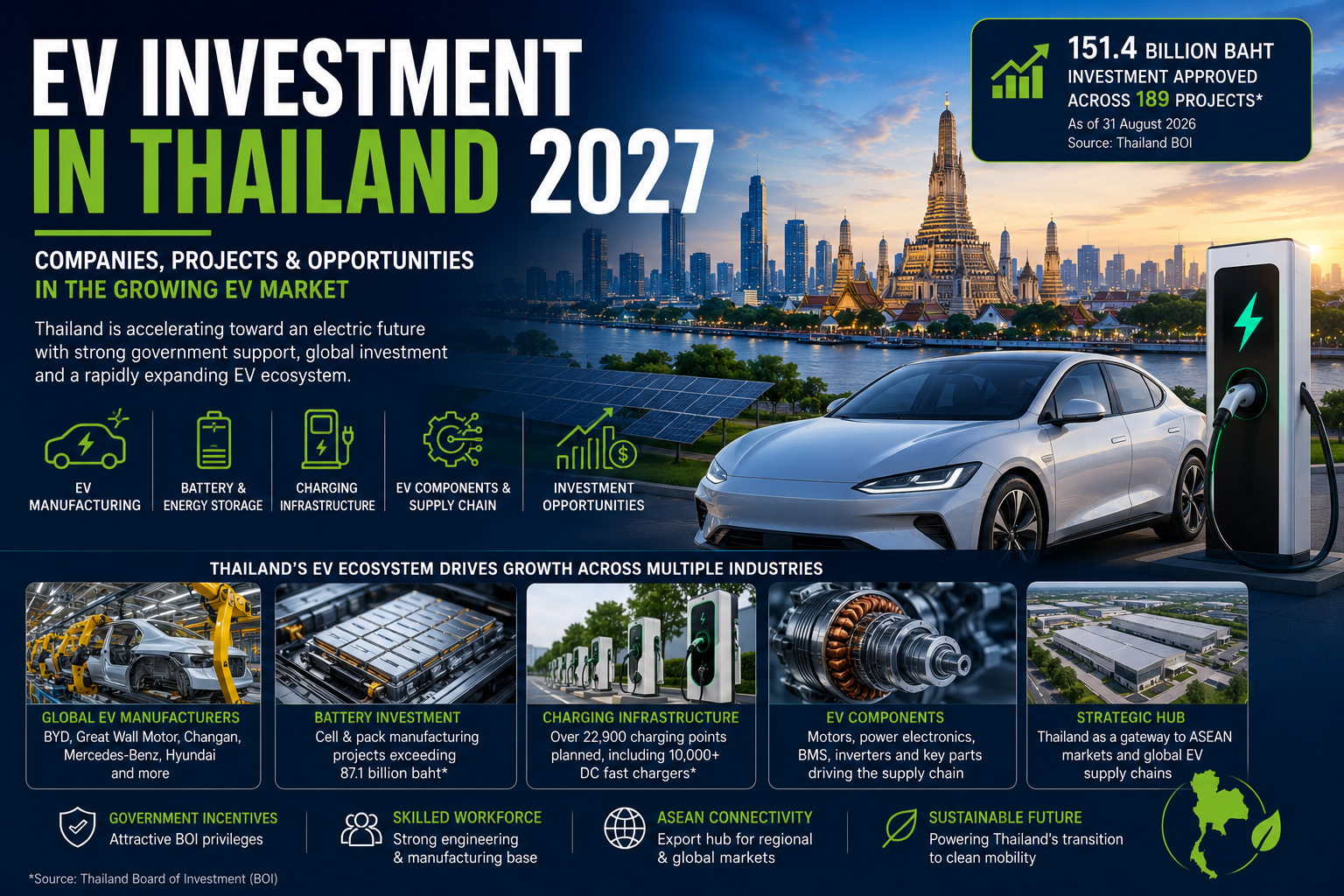
According to Thailand's Board of Investment (BOI), cumulative approved investment across the country's EV ecosystem reached approximately 151.4 billion baht across 189 projects as of 31 August 2026. Battery cell and pack manufacturing represented approximately 87.1 billion baht of that total, followed by battery-electric vehicle assembly at about 38.6 billion baht and core components at approximately 12.6 billion baht.
The scale and diversity of these projects make Thailand an important market to watch for EV investment in 2027.
Thailand's EV Investment Landscape in 2027
Thailand's EV investment ecosystem covers several interconnected areas:
Battery electric vehicle manufacturing
Hybrid and plug-in hybrid vehicle manufacturing
Battery cell and pack production
Energy storage systems
Electric motors
Battery management systems
Power electronics
EV charging infrastructure
Battery swapping
Automotive components
Smart mobility technology
EV software and connected vehicles
Automotive research and development
Recent BOI figures demonstrate how broad this investment base has become.
As of May 2026, BOI reported 198 approved EV-related projects worth more than 137 billion baht. These included 18 BEV projects worth approximately 39.5 billion baht, 14 HEV/PHEV projects worth approximately 39.3 billion baht, 57 battery and energy-storage projects worth 33.5 billion baht, 49 key-component projects worth 12.5 billion baht and 42 charging/battery-swapping projects worth 9.8 billion baht.
The later August 2026 BOI figures show that approved investment had continued to grow.
Why Are Companies Investing in Thailand's EV Industry?
Several factors help explain the continuing investment activity.
1. Established Automotive Manufacturing Infrastructure
Thailand already has a large automotive manufacturing and supplier ecosystem.
This provides an existing industrial foundation for EV production.
Manufacturers can potentially access:
Automotive suppliers
Industrial estates
Manufacturing expertise
Logistics infrastructure
Engineering talent
Export infrastructure
Automotive component manufacturers
The country's established automotive supply chain is therefore an important part of its EV transition.
2. Government Investment Promotion
Thailand's Board of Investment provides investment-promotion measures covering areas of the EV ecosystem.
These measures extend beyond vehicle assembly to areas such as batteries, important EV components and charging infrastructure.
The EV 3.5 package, for example, was designed to support investment across the EV ecosystem during the 2024–2027 period. BOI describes the package as covering manufacturing from vehicles to batteries, key parts and charging stations.
For businesses considering Thailand as a manufacturing or regional investment base, understanding the available incentives and eligibility requirements is therefore an important part of investment planning.
Major EV Companies Investing in Thailand
Thailand's EV ecosystem includes investments from companies headquartered in China, Japan, Europe and South Korea.
The BOI has reported that several manufacturers have already started BEV production in Thailand.
These include:
Mercedes-Benz
Great Wall Motor
SAIC Motor-CP
BYD
AION
Changan
EV Primus
BMW
Hyundai Mobility
OMODA & JAECOO
BOI reported that these manufacturers collectively employ more than 16,000 Thai workers.
This illustrates an important change in Thailand's automotive industry: EV investment is moving from announcements toward local manufacturing operations and supply-chain development.
BYD and the Expansion of EV Manufacturing
BYD is among the major Chinese EV manufacturers that have established production operations in Thailand.
Its presence is significant because vehicle manufacturing can create demand throughout the local supply chain.
Potential areas of opportunity include:
Automotive components
Battery-related products
Electronics
Charging systems
Manufacturing equipment
Logistics
Engineering services
Maintenance
Software
As Thailand develops its EV manufacturing base, opportunities can extend beyond the vehicle manufacturers themselves.
Changan's EV Investment in Thailand
Changan Automobile has also invested in Thailand's EV manufacturing ecosystem.
The Thailand BOI announced an 8.8 billion baht investment plan for a factory producing electric and hybrid vehicles, with a first-phase annual capacity of 100,000 vehicles. The planned facility was designed to serve Thailand, ASEAN and export markets.
The project illustrates another important aspect of Thailand's EV strategy: using the country not only as a domestic sales market but also as a potential regional production and export base.
Hyundai Mobility's EV and Battery Investment
South Korean automaker Hyundai is another company expanding its local manufacturing presence.
Thailand's BOI approved approximately 1 billion baht in investment promotion for Hyundai Mobility Manufacturing to assemble BEVs and batteries locally starting in 2026.
The project is particularly relevant because it combines vehicle assembly with battery production.
This reflects the increasing importance of localising more of the EV value chain rather than importing complete vehicles and major components.
Battery Investment in Thailand
Battery manufacturing is one of the most important parts of Thailand's EV investment strategy.
According to BOI's August 2026 figures, battery cell and pack manufacturing accounted for approximately 87.1 billion baht of approved investment across the EV ecosystem, making batteries the largest investment category reported in that update.
Earlier BOI data from May 2026 recorded 33.5 billion baht across 57 battery and energy-storage projects.
Battery investment can create opportunities across multiple stages of the value chain.
These include:
Battery cells
Battery modules
Battery packs
Battery management systems
Battery testing
Thermal management
Energy storage systems
Battery recycling
Battery materials
Battery software
Manufacturing equipment
The growth of battery manufacturing could therefore have implications well beyond the automotive industry.
EV Charging Infrastructure Investment
An expanding EV market requires an expanding charging network.
Thailand's BOI reported in May 2026 that approved investment in charging infrastructure and battery swapping reached approximately 9.8 billion baht across 42 projects, with more than 22,900 charging points planned, including more than 10,000 high-speed DC chargers.
This creates potential opportunities in:
Public charging stations
Highway charging
Destination charging
Fleet charging
Workplace charging
Apartment charging
Charging management software
Payment systems
Energy management
Charging hardware
Maintenance services
The charging sector is therefore an important part of the broader EV investment story.
EV Components and Supply Chain Opportunities
Vehicle manufacturers require much more than batteries and vehicle bodies.
The expansion of EV production creates demand for advanced components and technologies.
BOI reported approximately 12.5 billion baht across 49 projects for important EV components as of May 2026. These included areas such as drive motors, battery management systems and power-control systems.
For Thai and international suppliers, potential areas include:
Electric motors
Inverters
Battery management systems
Power control units
On-board chargers
DC-DC converters
Sensors
Electronic control units
Thermal management
Wiring systems
Automotive electronics
Lightweight components
This is particularly relevant for traditional automotive suppliers looking to transition into the EV supply chain.
Opportunities for Thai Automotive Suppliers
The EV transition is creating opportunities for existing Thai manufacturers to become suppliers to new EV manufacturers.
BOI reported that it has conducted 18 sourcing events, connecting more than 800 qualified Thai parts manufacturers with multinational automakers. According to BOI, these activities generated more than 1,200 business matches and could lead to approximately 60 billion baht in domestic procurement value.
This highlights a key opportunity:
Thailand's EV growth is not only about attracting foreign vehicle manufacturers. It is also about integrating local suppliers into the new EV value chain.
Companies that can provide advanced components, electronics, software, engineering and manufacturing capabilities may find opportunities as vehicle production expands.
Investment Opportunities Beyond EV Manufacturing
One of the most important developments in Thailand's EV ecosystem is the expansion into adjacent industries.
Energy Storage
EV batteries and stationary energy storage share technologies and supply-chain elements.
This creates potential opportunities in:
Battery systems
Energy storage
Battery management
Power electronics
Energy management software
Smart Mobility
Electric vehicles increasingly operate as connected digital platforms.
Investment opportunities can therefore extend into:
Fleet management
Connected vehicles
Mobility platforms
Intelligent transportation systems
AI
Data analytics
Vehicle software
Smart-city technology
EV Fleet Electrification
Commercial fleets are another potential area of growth.
Businesses operating:
Delivery vehicles
Taxis
Buses
Logistics fleets
Corporate vehicles
Last-mile transport
may increasingly require charging, fleet-management and energy solutions.
Thailand's EV Export Opportunity
Thailand's automotive industry has historically served both domestic and export markets.
The EV transition is creating an opportunity to build on that role.
Thailand's EV policy has included measures designed to encourage manufacturers to use the country as an export base. BOI previously reported adjustments to EV3 and EV3.5 requirements intended to make exports more useful in meeting manufacturers' production commitments.
For investors, this means the potential addressable market for a Thailand-based EV manufacturing operation can extend beyond Thailand itself.
A factory in Thailand can potentially serve customers across ASEAN and other export markets, depending on the company, product, trade arrangements and regulatory requirements.
Local Content Is Becoming More Important
Thailand is also encouraging greater use of locally manufactured components.
BOI's local-content promotion measure establishes minimum local-content requirements for certain promoted activities, including:
BEV: 40%
PHEV: 45%
Electric buses and trucks: 40%
EV equipment: 15%
The measure also includes a 50% corporate-income-tax reduction on qualifying net profits for two years after the corporate-income-tax exemption period ends, subject to the stated conditions.
This is important for investors because it increases the potential strategic value of local supplier relationships.
For companies entering Thailand, the question is therefore not simply:
“Where can we manufacture?”
It can also be:
“Which parts of our supply chain can be localised?”
What Are the Biggest EV Investment Opportunities in Thailand in 2027?
Several areas stand out for businesses evaluating the market.
1. Battery Manufacturing
Battery cell, module and pack manufacturing represents a major part of Thailand's approved EV investment ecosystem.
2. EV Charging
Charging infrastructure will be needed as vehicle adoption expands.
3. EV Components
Motors, electronics, power systems and battery-management technologies represent opportunities for suppliers.
4. Automotive Manufacturing
Thailand's established automotive industry provides an industrial base for EV production.
5. Fleet Electrification
Commercial fleets can create demand for vehicles, charging and fleet-management solutions.
6. Energy Storage
Battery and energy-storage technology connects the EV ecosystem with the wider energy transition.
7. Smart Mobility
Connected vehicles, intelligent transport, AI and mobility platforms can create new technology opportunities.
8. EV Software
The transition from conventional vehicles to connected electric vehicles creates demand for digital services and software.
What Challenges Should EV Investors Consider?
Thailand's EV market also presents challenges that businesses should evaluate before investing.
Competition
The rapid arrival of international manufacturers increases competition for customers, suppliers and talent.
Supply Chain Development
Not every EV component can necessarily be sourced locally at the required scale or technical specification.
Technology Changes
Battery chemistry, charging standards, vehicle software and manufacturing technologies continue to evolve.
Infrastructure
Charging infrastructure needs to develop alongside vehicle adoption.
Policy Changes
EV incentives, taxation and industrial policies can change over time, making regulatory monitoring important for long-term investment planning.
Workforce Skills
Advanced EV manufacturing requires skills in electronics, software, batteries, automation and power systems in addition to traditional automotive manufacturing.
Investors should therefore evaluate Thailand as a complete ecosystem rather than looking at vehicle production alone.
Why 2027 Could Be an Important Year for Thailand's EV Industry
Thailand's EV ecosystem is entering a more mature stage.
Earlier investment was focused heavily on establishing vehicle manufacturing capacity. The next stage involves strengthening the supporting ecosystem around those factories.
That includes:
Local suppliers
Battery manufacturing
Charging networks
Energy storage
Automotive electronics
Software
Fleet solutions
Smart mobility
Research and development
Export supply chains
The investment figures released by BOI during 2026 show that this broader ecosystem is already attracting substantial capital.
For companies considering Southeast Asia, 2027 is therefore a useful year to monitor developments in Thailand's EV supply chain and investment landscape.
Why EV Industry Leaders Should Attend EV Events in Thailand
Investment decisions are rarely made in isolation.
Companies evaluating Thailand may need to meet:
Automotive manufacturers
Parts suppliers
Charging companies
Battery companies
Government representatives
Technology providers
Investors
Fleet operators
Mobility startups
Industry conferences and exhibitions can provide opportunities to understand the market and establish these relationships.
For businesses exploring Thailand's EV ecosystem, events such as the EV Smart Mobility Conference 2027 can provide a platform for discussions around EV technology, investment, charging infrastructure, smart mobility and industry collaboration.
The EV Smart Mobility Conference 2027 will take place in Bangkok on 10–11 May 2027 and combines a conference, expo and awards programme.
Thailand's EV Investment Outlook
Thailand's EV investment story is becoming increasingly diversified.
The country is not only attracting investment into electric cars. The ecosystem now includes:
Vehicles → Batteries → Components → Charging → Energy Storage → Software → Smart Mobility → Exports
The latest BOI figures provide evidence of this diversification, with approved investment spanning battery production, BEV assembly, core components and other parts of the EV ecosystem.
For investors, manufacturers and technology companies, this means Thailand's EV opportunity can be considered at several different levels.
A company does not necessarily need to manufacture an entire electric vehicle to participate in the country's EV growth.
It could supply a battery component, charging system, software platform, electronic component, fleet-management solution or manufacturing technology.
Frequently Asked Questions
What is the current level of EV investment in Thailand?
Thailand's BOI reported approximately 151.4 billion baht across 189 approved EV-related projects as of 31 August 2026. The investment covers areas including battery manufacturing, BEV assembly and core components.
Which companies are investing in EV manufacturing in Thailand?
Companies with BEV production operations reported by BOI include Mercedes-Benz, Great Wall Motor, SAIC Motor-CP, BYD, AION, Changan, EV Primus, BMW, Hyundai Mobility and OMODA & JAECOO.
Is Thailand attracting battery investment?
Yes. Battery cell and pack manufacturing represented approximately 87.1 billion baht of cumulative BOI-approved EV ecosystem investment as of 31 August 2026.
Is EV charging infrastructure growing in Thailand?
BOI reported approximately 9.8 billion baht in charging and battery-swapping investment across 42 projects as of May 2026, covering more than 22,900 planned charging points.
What are the main EV investment opportunities in Thailand?
Opportunities span vehicle manufacturing, batteries, charging infrastructure, EV components, energy storage, fleet electrification, software, connected vehicles and smart mobility.
Does Thailand offer incentives for EV investment?
Thailand's BOI has investment-promotion measures covering parts of the EV ecosystem, including manufacturing and local-content initiatives. Eligibility, conditions and benefits vary by activity and should be checked against the latest BOI rules before making investment decisions.
Why is local content important for EV investors?
Thailand has introduced measures encouraging the use of locally manufactured components. For qualifying promoted activities, BOI specifies local-content requirements such as 40% for BEVs and 45% for PHEVs under its local-parts promotion measure.
Is Thailand an important EV market in Southeast Asia?
Thailand has an established automotive manufacturing base and substantial investment across EV vehicles, batteries, components and charging infrastructure. BOI's investment data indicates that the country is developing a broad EV manufacturing and supply-chain ecosystem.
Conclusion
EV investment in Thailand in 2027 is about much more than electric car manufacturing.
The country's EV ecosystem is expanding across batteries, charging infrastructure, components, energy storage, smart mobility and connected transportation.
The latest BOI data shows substantial approved investment across these segments, while international manufacturers are establishing or expanding production operations in the country.
For investors and businesses, the opportunity is therefore increasingly distributed across the entire EV value chain.
As Thailand continues developing its position within Southeast Asia's automotive industry, 2027 will be an important year for companies looking to understand, enter or expand within the country's electric mobility ecosystem.
And for companies looking to meet the people and businesses shaping this ecosystem, Bangkok's EV conferences, exhibitions and smart mobility events provide an important place to connect, learn and explore new opportunities.