
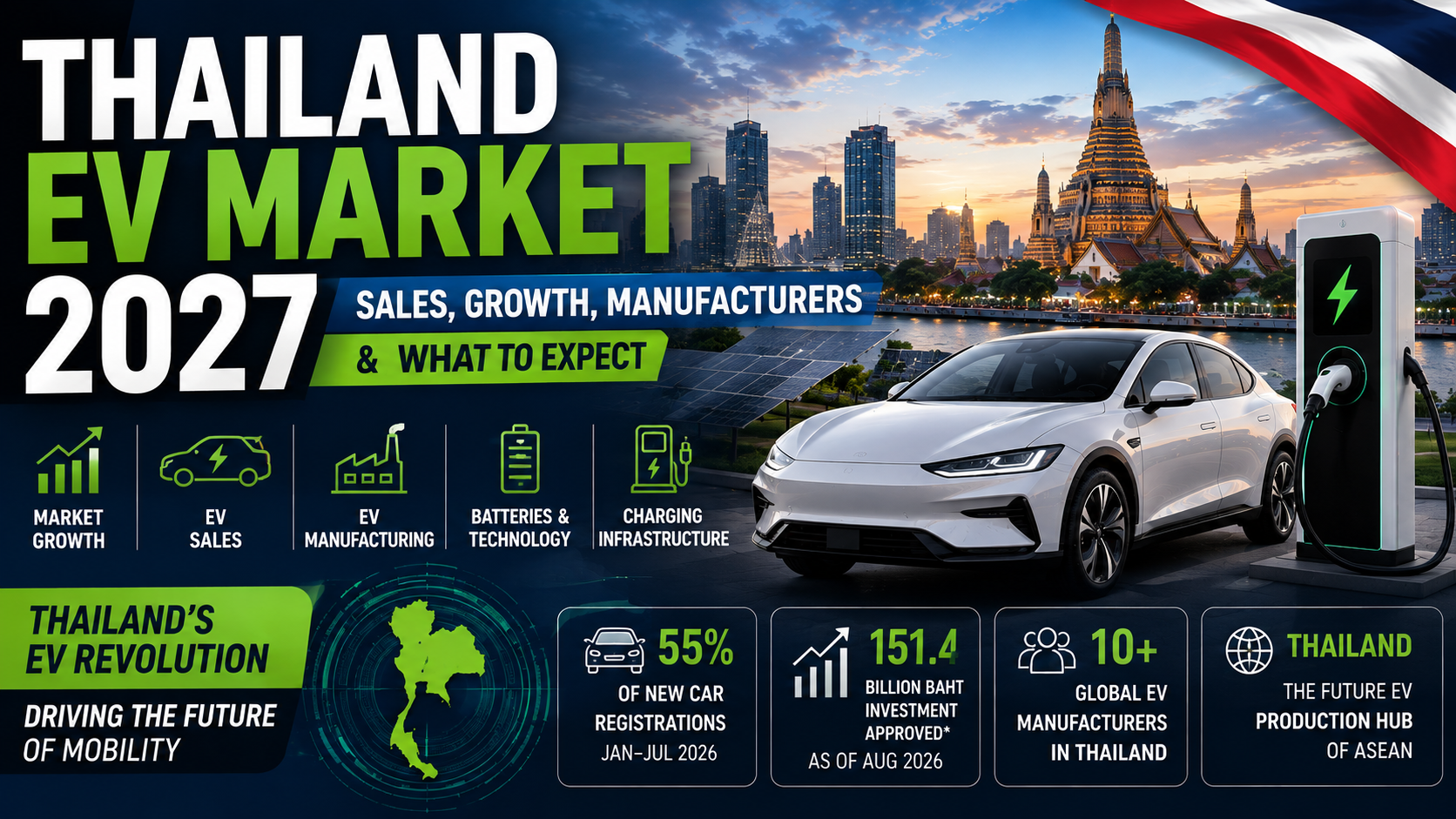
Thailand EV Market 2027: Sales, Growth, Manufacturers & What to Expect
Thailand is entering a new phase of its electric vehicle transition.
The country's automotive industry has historically been one of Southeast Asia's major manufacturing hubs, producing vehicles and components for both domestic and international markets. The growth of electric vehicles is now reshaping that industry, with new investments in battery electric vehicles, hybrid vehicles, batteries, components, charging infrastructure and automotive technology.
The shift is already visible in the market.
According to Thailand's Board of Investment, electric and hybrid vehicles accounted for 55% of new-car registrations during the first seven months of 2026. This was the first time the combined share of battery-electric, hybrid and plug-in hybrid vehicles exceeded that of conventional combustion-engine vehicles in Thailand.
At the same time, Thailand is developing its domestic EV manufacturing capabilities.
As of 31 August 2026, cumulative Board of Investment approvals across Thailand's EV ecosystem reached approximately 151.4 billion baht across 189 projects. Battery cell and pack manufacturing represented about 87.1 billion baht, BEV assembly about 38.6 billion baht, and core components about 12.6 billion baht.
So what could the Thailand EV market look like in 2027?
This guide examines the market's growth, manufacturers, production, batteries, charging infrastructure, government policy and the trends businesses should watch.
Thailand EV Market 2027: Overview
Thailand's EV market is developing across several vehicle technologies:
Battery electric vehicles (BEVs)
Hybrid electric vehicles (HEVs)
Plug-in hybrid electric vehicles (PHEVs)
Electric buses
Electric commercial vehicles
Electric motorcycles
Other electric mobility solutions
This makes Thailand different from a market where electrification is focused exclusively on battery-electric passenger cars.
The country's policy framework is increasingly designed around a broader automotive transformation, with the government seeking to maintain Thailand's position as an automotive manufacturing and export hub while encouraging greater local value creation.
In September 2026, Thailand's National Electric Vehicle Policy Committee agreed in principle to restructure vehicle excise taxation around factors including local investment, domestic assembly, local supply-chain integration and skilled employment.
That policy direction is important for understanding the 2027 market.
Thailand's EV story is increasingly about local production and industrial development, not simply imported electric cars.
How Fast Is the Thailand EV Market Growing?
Thailand's electric vehicle market has expanded rapidly in recent years.
The International Energy Agency reported that electric car sales in Thailand increased by approximately 70% in 2025 compared with 2024, reaching roughly 140,000 vehicles, or nearly one-quarter of total new-car sales. The IEA identified Thailand as the second-largest electric-car market in Southeast Asia in 2025.
The IEA also reported that Thai-made electric cars increased their share of the domestic market from around 5% in 2024 to approximately 20% in 2025.
This is an important change.
Thailand's market is gradually moving from:
Imported EVs → Local assembly → Local supply chain → Regional EV manufacturing
That transition is likely to remain one of the major themes of the Thailand EV market in 2027.
What Is the EV Sales Outlook for Thailand in 2027?
Forecasts should be treated differently from historical sales data.
Krungsri Research's 2026–2028 industry outlook projects that new passenger BEV registrations in Thailand will average approximately 125,000 units per year during 2026–2028, representing a projected CAGR of about 3.8%.
The research identifies several factors supporting demand:
New EV models
Longer driving ranges
Improving vehicle technology
Greater local production
Changes in conventional-vehicle costs
Expansion of charging infrastructure
However, the outlook also identifies potential constraints, including the end of EV3.5 purchase subsidies and continued competition among manufacturers.
Therefore, 2027 should not simply be viewed as a year of unlimited EV growth.
Instead, it is likely to be a year in which market growth and industrial competition develop alongside each other.
BEV, HEV and PHEV: What Is Growing in Thailand?
The term "EV market" includes several technologies.
Battery Electric Vehicles
BEVs run entirely on electric power and have no conventional internal-combustion engine.
Thailand has attracted substantial BEV manufacturing investment from both Chinese and established international automotive companies.
Hybrid Electric Vehicles
HEVs combine an internal-combustion engine with an electric powertrain.
Thailand has a long-established hybrid manufacturing ecosystem, particularly among Japanese automakers.
Plug-in Hybrid Electric Vehicles
PHEVs combine an internal-combustion engine with a rechargeable battery that can be charged externally.
Thailand's policy framework continues to support multiple electrified powertrain technologies rather than focusing exclusively on BEVs.
The BOI's May 2026 figures included approximately 39.5 billion baht in BEV projects, 29.9 billion baht in HEV projects and 9.4 billion baht in PHEV projects.
This demonstrates the breadth of Thailand's electrification strategy.
Major EV Manufacturers in Thailand
Thailand's EV manufacturing ecosystem now includes companies from China, Japan, Germany, South Korea and other markets.
The BOI reports that manufacturers that have started BEV production in Thailand include:
Mercedes-Benz
Great Wall Motor
SAIC Motor-CP
BYD
AION
Changan
EV Primus
BMW
Hyundai Mobility
OMODA & JAECOO
Together, these manufacturers employ more than 16,000 Thai workers, according to the BOI.
This growing manufacturer base is changing the competitive structure of Thailand's automotive market.
BYD and the Thailand EV Market
BYD has become one of the most visible Chinese EV manufacturers in Thailand.
Its local production is also an example of the broader shift toward manufacturing vehicles inside Thailand rather than relying entirely on imports.
The IEA notes that BYD moved production of Thailand's best-selling BEV model, the Dolphin, from China to its Thai facilities during 2025.
Local production can potentially help manufacturers:
Reduce import exposure
Build local supply chains
Meet production requirements
Serve the domestic market
Develop export opportunities
BYD is therefore part of a larger trend involving Chinese manufacturers establishing manufacturing capacity across Southeast Asia.
Great Wall Motor and Thailand
Great Wall Motor is another Chinese manufacturer that has established EV manufacturing operations in Thailand.
The company's local presence contributes to Thailand's transition from a conventional automotive production centre toward a multi-technology manufacturing base.
The BOI identifies Great Wall Motor among the manufacturers that have established domestic EV assembly operations.
For the wider industry, these investments create potential demand for local suppliers, logistics companies, engineering services and EV components.
Changan's Role in Thailand's EV Manufacturing
Changan has also established manufacturing operations in Thailand.
The company is part of a wider group of Chinese manufacturers expanding production capacity in Southeast Asia.
Its investment illustrates how Thailand is increasingly being used as a regional manufacturing location rather than simply as an import market.
This trend is particularly important for the 2027 outlook because local production can affect:
Vehicle availability
Pricing
Supply chains
Component sourcing
Exports
Employment
Technology transfer
European and Japanese Automakers in Thailand's EV Transition
Thailand's EV market is not exclusively a Chinese-manufacturer story.
Established Japanese and European manufacturers are also adapting their Thai operations.
Mercedes-Benz has produced electric vehicles and batteries in Thailand since 2022, while BMW has been expanding its EV manufacturing capabilities. BOI reports that BMW began production of locally made EVs and had invested in a high-voltage battery facility in Rayong.
The transition is also influencing Japanese manufacturers.
According to the BOI's September 2026 update, Honda, Mitsubishi Motors, Isuzu and Mazda had collectively committed approximately 50.4 billion baht to upgrade Thai assembly operations with robotics and automation supporting hybrid, mild-hybrid and electric vehicle platforms.
This indicates that Thailand's existing automotive manufacturers are adapting rather than disappearing from the electrification story.
Thailand's EV Manufacturing Capacity
Manufacturing is becoming one of the most important components of Thailand's EV strategy.
The IEA estimates that Southeast Asia has become an important location for overseas manufacturing by Chinese automakers, with Thailand hosting more than 30% of Chinese firms' overseas dual ICE-EV manufacturing footprint in the region in 2025.
However, the transition from announced capacity to efficient, high-volume production takes time.
Manufacturers must develop:
Local suppliers
Skilled labour
Production systems
Battery supply
Quality-control systems
Logistics
Export networks
This is one reason why 2027 could be an important year for Thailand's automotive industry.
EV Battery Manufacturing in Thailand
The EV market cannot grow sustainably without batteries.
Thailand is therefore developing local battery production alongside vehicle manufacturing.
As of 31 August 2026, battery cell and pack manufacturing represented approximately 87.1 billion baht of approved investment within Thailand's EV ecosystem, according to the BOI.
The country's battery ecosystem includes:
Battery cells
Battery modules
Battery packs
Battery management systems
Energy storage systems
Battery testing
Battery-related components
Battery investment can also create opportunities beyond passenger vehicles.
Energy storage, commercial fleets and renewable-energy systems can all benefit from advances in battery technology.
EV Charging Infrastructure in Thailand
More EVs require more charging infrastructure.
Thailand's charging network is expanding alongside vehicle production.
According to the BOI's May 2026 figures, investment-promoted charging projects were expected to provide more than 22,900 charging points, including more than 10,000 high-speed DC fast chargers.
By August 2026, the BOI reported 23,135 commercial charging dispensers planned through investment-promoted projects, including 10,249 DC fast-charging outlets. The BOI said this represented about 85% of Thailand's nationwide 2030 target of 12,000 fast DC charging units.
Charging infrastructure will remain an important part of the Thailand EV market in 2027.
EV Charging Opportunities Beyond Bangkok
Bangkok is an important centre for EV adoption and charging infrastructure, but the national market extends well beyond the capital.
As EV ownership expands, charging demand will increasingly involve:
Highways
Provincial cities
Shopping centres
Hotels
Offices
Residential developments
Industrial estates
Logistics hubs
Fleet depots
Krungsri Research has identified the availability of charging stations in provincial areas as one factor that could constrain growth in electric buses and commercial vehicles.
This suggests that expanding charging coverage outside major urban areas will remain an important industry challenge.
Thailand's EV Supply Chain
The development of an EV market creates opportunities beyond vehicle manufacturers.
Thailand is encouraging domestic production of high-value components such as:
Electric motors
Battery management systems
Power-control units
Electronics
Charging equipment
Automotive components
BOI reported approximately 12.5 billion baht across 49 projects focused on important EV components as of May 2026.
The government has also been connecting Thai parts manufacturers with multinational automakers.
BOI reported that its sourcing activities had connected more than 800 Thai parts manufacturers with multinational automakers, generating more than 1,200 business matches and potentially more than 60 billion baht in domestic procurement value.
This creates opportunities for companies that can adapt traditional automotive manufacturing capabilities to electric powertrains.
Thailand EV Policy and EV 3.5
Government policy remains an important driver of Thailand's EV market.
Thailand's EV3.5 package covers the 2024–2027 period and was designed to encourage EV adoption while supporting investment in domestic EV manufacturing. The policy forms part of Thailand's broader objective of becoming a regional EV manufacturing hub.
However, the policy environment is evolving.
As Thailand moves further into local production, policy emphasis is shifting toward:
Domestic investment
Local assembly
Local content
High-value components
Skilled employment
Export capability
The September 2026 policy announcement indicates that future vehicle taxation will increasingly reflect the amount of economic value created within Thailand.
For manufacturers, this makes localisation increasingly important.
Local Content and the Future of Thailand's EV Industry
Thailand's BOI has established measures encouraging companies to use locally manufactured components.
Under the current local-parts promotion measure, minimum local-content requirements include:
40% for BEVs
45% for PHEVs
40% for battery-electric buses and trucks
15% for EV equipment
Qualifying projects can also receive a 50% reduction in corporate income tax on net profits from the promoted activity for two years after the corporate-income-tax exemption period, subject to the measure's conditions.
For the 2027 market, this means the development of Thai suppliers will be increasingly important.
Thailand as an EV Export Hub
Thailand has historically been an important vehicle-exporting country.
The EV transition creates an opportunity to extend that position into electric vehicles.
The IEA notes that Thailand has increasingly shifted policy toward local EV manufacturing and exports. It also reports that passenger BEV exports from Thailand reached 12,695 units in 2025, equivalent to 5.5% of overall passenger-car exports.
The long-term opportunity is potentially larger as manufacturers increase local production.
Thailand's geographic position also makes it relevant to regional supply chains across Southeast Asia.
What Will Drive the Thailand EV Market in 2027?
Several factors are likely to shape the market.
1. More Locally Produced EVs
As manufacturers fulfil production commitments, more vehicles are expected to be manufactured locally.
2. More EV Models
Competition is encouraging manufacturers to introduce additional models and vehicle segments.
Krungsri Research expects new models with longer driving ranges to support passenger BEV demand during 2026–2028.
3. Battery Investment
Growing battery production should support vehicle manufacturing and potentially improve supply-chain resilience.
4. Charging Expansion
The continued rollout of fast chargers and commercial charging infrastructure will support EV adoption.
5. Local Supply Chains
More local components can reduce reliance on imported parts and increase Thailand's manufacturing value.
6. Export Growth
Manufacturers may increasingly use Thailand as a production base for regional and global markets.
What Challenges Could Affect Thailand's EV Market?
Growth is not guaranteed to be uniform.
Several challenges could influence the market in 2027.
Consumer purchasing power
Vehicle affordability remains important, particularly as households face broader economic pressures.
Competition
The arrival of many EV brands increases consumer choice but also creates intense competition among manufacturers.
Production scale
Local factories need to reach sufficient production volumes to become cost competitive.
Charging availability
Charging infrastructure must expand beyond major urban areas.
Policy changes
Changes to subsidies, taxes and import rules can affect both consumer demand and manufacturer strategy.
Global competition
Thailand competes with other Asian manufacturing locations for EV investment.
Krungsri Research specifically notes continued competition, limited economies of scale and possible pressure on exports as challenges for Thailand's EV industry.
Thailand EV Market vs Southeast Asia
Thailand is part of a rapidly changing Southeast Asian EV market.
The IEA reported that electric-car sales across Southeast Asia more than doubled in 2025 to more than half a million vehicles, with Thailand, Vietnam and Indonesia among the leading markets for growth.
Thailand has a particular advantage in manufacturing because it already possesses a mature automotive industrial base.
This gives Thailand a different position from markets that are primarily dependent on imported vehicles.
The competition across Southeast Asia, however, is increasing as Indonesia, Vietnam and other markets develop their own EV manufacturing and policy strategies.
What to Expect From the Thailand EV Market in 2027
Based on current industry data and announced policy direction, several trends are worth watching in 2027.
More local production
EV manufacturing capacity established during 2024–2026 should become increasingly important.
Greater competition
Consumers are likely to have access to a wider range of EV models and brands.
Stronger battery ecosystem
Battery cell, pack and energy-storage investment should continue to support the EV supply chain.
Continued charging investment
The charging network should continue expanding as vehicle numbers increase.
More local suppliers
Automotive suppliers will face increasing pressure to develop EV-compatible components and technology.
Growing export ambitions
Thailand is increasingly positioning itself as a regional EV manufacturing and export centre.
Policy focus on local value
Future policy is increasingly connected to local investment, production, components and skilled employment.
Is Thailand Becoming an EV Manufacturing Hub?
Thailand's current investment and production data indicate that the country is developing a substantial EV manufacturing ecosystem.
The BOI's August 2026 data shows 151.4 billion baht of approved EV investment across 189 projects, while multiple global automakers have established or expanded local production.
However, "hub" can mean different things.
It can refer to:
Vehicle production
Component manufacturing
Battery production
Export activity
Technology development
Regional supply chains
Thailand is developing capabilities across several of these areas, but the scale and competitiveness of each segment will continue to evolve.
What Does the Thailand EV Market Mean for Businesses?
The EV transition creates opportunities for businesses beyond automakers.
Companies can participate through:
Automotive components
Motors, electronics, power systems and sensors.
Batteries
Cells, packs, battery management and energy storage.
Charging
Hardware, software, networks and installation.
Fleet technology
Fleet management, route optimisation and charging management.
Smart mobility
Connected vehicles, AI, traffic management and mobility platforms.
Manufacturing technology
Automation, robotics, testing and quality control.
Energy
Renewable energy, storage and intelligent energy management.
This makes Thailand's EV market relevant to a much wider group of companies than traditional automotive manufacturers.
Why Bangkok Matters to Thailand's EV Industry
Bangkok remains an important business and technology centre for Thailand's EV ecosystem.
The city brings together:
Automotive companies
Technology providers
Charging companies
Investors
Government agencies
Mobility startups
Fleet operators
Industry associations
International businesses
This is one reason why Bangkok has become a major location for EV conferences, exhibitions and smart mobility events.
For companies researching the Thailand EV market, industry events can provide opportunities to meet potential partners and understand developments across the wider ecosystem.
The EV Smart Mobility Conference 2027, for example, will take place in Bangkok on 10–11 May 2027, combining a conference, expo and awards programme.
You can naturally link this section to your conference page here:
EV Smart Mobility Conference 2027
Thailand EV Market 2027: Key Numbers at a Glance
Indicator | Latest reported figure |
|---|---|
Electric + hybrid share of new-car registrations, Jan–Jul 2026 | 55% |
EV ecosystem approved investment, Aug. 2026 | 151.4 billion baht |
Approved EV ecosystem projects | 189 |
Battery cell & pack investment | 87.1 billion baht |
BEV assembly investment | 38.6 billion baht |
Core component investment | 12.6 billion baht |
Planned commercial charging dispensers | 23,135 |
Planned DC fast-charging outlets | 10,249 |
Passenger BEV annual registrations projected for 2026–28 | 125,000 average/year |
Sources: Thailand BOI and Krungsri Research.
Frequently Asked Questions
Is Thailand's EV market growing?
Yes. The IEA reported that electric-car sales in Thailand increased approximately 70% in 2025, reaching around 140,000 vehicles and nearly one-quarter of new-car sales.
What is the Thailand EV market outlook for 2027?
Industry forecasts point to continued growth, although at a more moderate pace. Krungsri Research projects average annual passenger BEV registrations of approximately 125,000 units during 2026–2028.
Which EV manufacturers are producing vehicles in Thailand?
Manufacturers identified by the Thailand BOI include Mercedes-Benz, Great Wall Motor, SAIC Motor-CP, BYD, AION, Changan, EV Primus, BMW, Hyundai Mobility and OMODA & JAECOO.
Are Chinese EV companies important in Thailand?
Yes. Chinese manufacturers have become an important part of Thailand's EV market and manufacturing expansion. The IEA reported that Chinese-made EVs represented about three-quarters of Thailand's electric-car market in 2025, while local production was increasing.
Is Thailand producing EV batteries?
Yes. Battery cell and pack manufacturing is receiving substantial investment. BOI reported approximately 87.1 billion baht in approved battery cell and pack investment as of August 2026.
How many EV charging stations are planned in Thailand?
BOI reported 23,135 commercial charging dispensers planned through investment-promoted projects as of August 2026, including 10,249 DC fast-charging outlets.
Is Thailand an EV manufacturing hub in Southeast Asia?
Thailand has developed significant EV manufacturing, battery, component and charging investment and is positioning itself as a regional production and export centre. The extent of its future role will depend on production scale, competitiveness, supply-chain development and policy.
What are the biggest opportunities in Thailand's EV market?
Major opportunities include EV manufacturing, batteries, components, charging infrastructure, energy storage, fleet electrification, smart mobility, automotive software and manufacturing technology.
Conclusion
The Thailand EV market in 2027 is entering an important stage.
The country's transition is no longer only about increasing EV sales. It is increasingly about building a complete industrial ecosystem around electric mobility.
That ecosystem includes:
EVs → Batteries → Components → Charging → Energy → Manufacturing → Smart Mobility → Exports
The latest data shows substantial investment across these areas. Electric and hybrid vehicles already represented 55% of new-car registrations during the first seven months of 2026, while BOI-approved EV investment reached approximately 151.4 billion baht across 189 projects by August 2026.
At the same time, international manufacturers are establishing production operations, battery investment is expanding, and Thailand is encouraging greater local content and domestic value creation.
For 2027, the key question is therefore not simply how many EVs Thailand will sell.
It is how successfully Thailand can transform growing EV demand into a competitive manufacturing, technology, supply-chain and export ecosystem.
That makes Thailand one of the important EV markets to watch in Southeast Asia as the region's electric mobility industry continues to develop.