
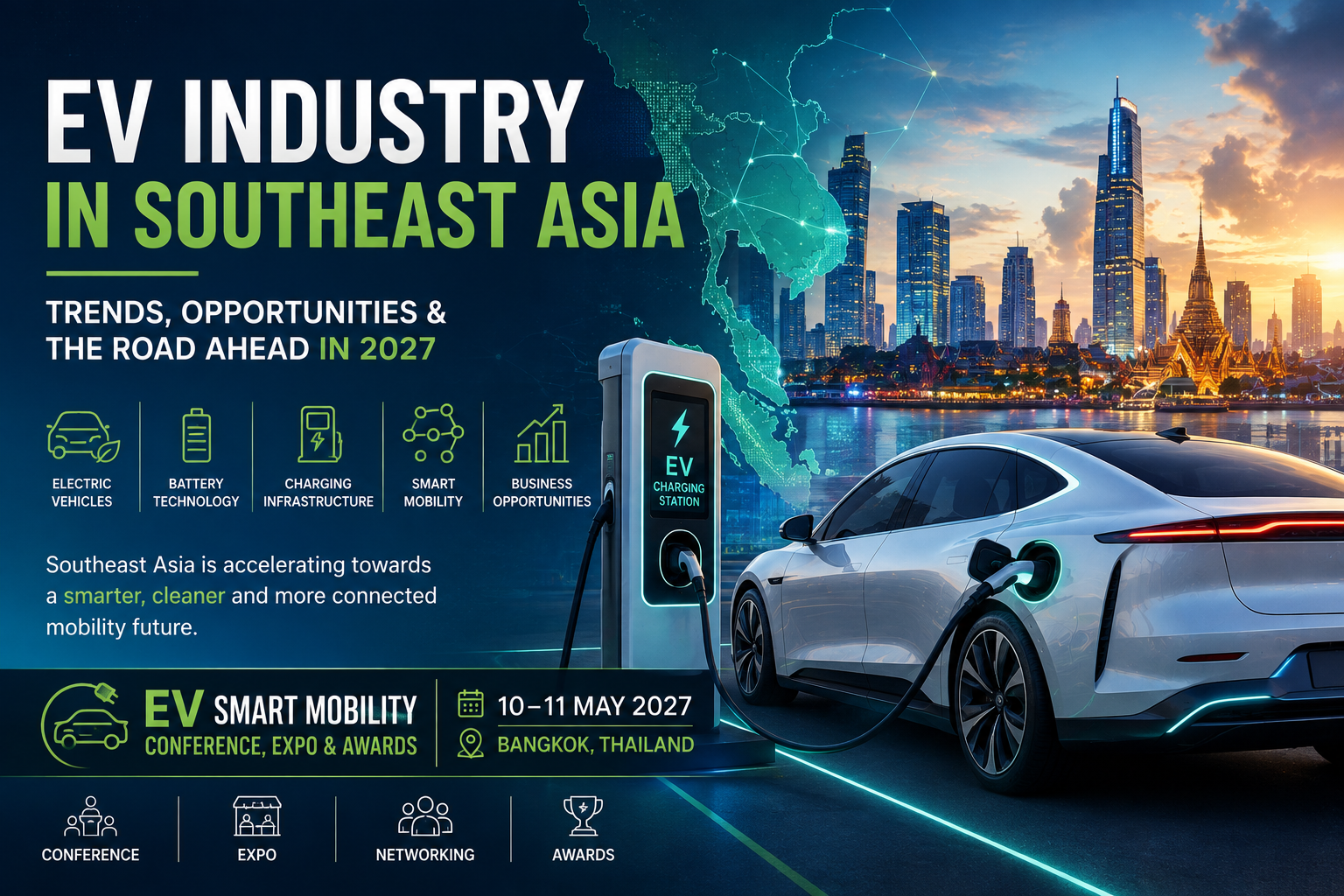
EV Industry in Southeast Asia: Trends, Opportunities and the Road Ahead in 2027
Southeast Asia is becoming an increasingly important region in the global electric vehicle transformation. Electric vehicle adoption, battery manufacturing, charging infrastructure and automotive investment are developing across several markets, creating new opportunities for manufacturers, technology companies, energy providers, mobility operators, investors and infrastructure developers.
Thailand is particularly significant in this transition. The country has a long-established automotive manufacturing base and is developing policies and investment incentives designed to strengthen its electric vehicle ecosystem.
The transition is also expanding beyond electric cars. Electric buses, commercial vehicles, two- and three-wheelers, charging networks, fleet management platforms, connected vehicles and smart energy systems are becoming important parts of the emerging mobility ecosystem.
According to the International Energy Agency, Thailand recorded around 140,000 electric-car sales in 2025, representing nearly one-quarter of new car sales. The IEA also reported that Thailand had nearly 12,000 public chargers in 2025.
These developments raise an important question:
What will the EV and smart mobility ecosystem in Southeast Asia look like as the region moves toward 2027?
Southeast Asia's Growing EV Opportunity
Southeast Asia combines large urban populations, expanding economies, established automotive supply chains and increasing demand for transportation.
Countries across the region are developing their own approaches to electric mobility, while Thailand, Indonesia, Vietnam, Malaysia and other markets are attracting investment into different parts of the EV value chain.
The opportunity extends across several areas:
Electric vehicle manufacturing
Battery manufacturing
EV components
Charging infrastructure
Fleet electrification
Smart mobility technology
Connected vehicles
Renewable energy
Energy storage
Mobility software
Automotive technology
This means the EV transition is no longer simply an automotive story.
It is becoming an energy, technology, infrastructure and mobility story.
Why Thailand Is Important to the Regional EV Industry
Thailand has been one of Southeast Asia's established automotive manufacturing hubs for decades.
As the global automotive industry moves toward electrification, Thailand is seeking to build on this manufacturing base by attracting investment in electric vehicles, batteries, components and supporting infrastructure.
Thailand's 30@30 policy targets zero-emission vehicles accounting for at least 30% of domestic vehicle production by 2030.
The country's investment promotion framework also supports activities related to electric vehicles, batteries, key components and charging infrastructure.
Thailand's Board of Investment has reported substantial investment interest across the EV ecosystem, including vehicle manufacturing, battery production, charging infrastructure and related components.
This combination of an established automotive industry and growing EV investment makes Thailand an important market for companies looking to participate in Southeast Asia's electric mobility transition.
The Growth of EV Charging Infrastructure
Electric vehicles cannot scale without charging infrastructure.
For consumers, charging availability affects convenience and long-distance travel.
For businesses, it can influence fleet utilization and operating schedules.
For cities, it creates new requirements for electricity distribution, parking and urban infrastructure.
Thailand's public charging network has expanded alongside EV adoption.
According to the International Energy Agency, Thailand had nearly 12,000 public chargers in 2025, with fast chargers making up around 60% of the public charging stock.
The development of charging infrastructure creates opportunities for:
Charge point operators
Energy companies
Automotive manufacturers
Real estate developers
Fleet operators
Technology companies
Infrastructure investors
Retail and hospitality businesses
The next phase of the charging market will not simply be about installing more charging points.
It will also be about where chargers are located, how they are managed, how they connect to the electricity network and how effectively they serve customers and fleets.
Fast Charging and Highway Infrastructure
As EV adoption increases, fast charging is becoming increasingly important.
A private EV owner may be able to charge at home overnight, but commercial vehicles, taxis, buses and long-distance travelers often require faster charging solutions.
Fast-charging infrastructure can be particularly relevant for:
Highways
Expressways
Electric taxis
Delivery fleets
Electric buses
Commercial vehicles
Logistics operations
The development of charging corridors can help connect major cities and transportation hubs.
This will be important for creating an EV ecosystem that supports not only urban driving but also regional mobility.
Smart Charging and the Connected Energy Ecosystem
The future of EV charging is increasingly connected to software.
Smart charging systems can use data to manage charging based on factors such as:
Vehicle requirements
Charging schedules
Electricity demand
Energy prices
Renewable-energy availability
Fleet requirements
Charger utilization
This creates a connection between the transportation and energy sectors.
A charging station can become more than a place where a vehicle receives electricity.
It can become part of an intelligent energy-management system.
The broader model can be represented as:
EVs + Charging + Energy Storage + Renewable Energy + Software + Data
This is one of the areas where electric mobility and smart mobility increasingly overlap.
The Rise of Fleet Electrification
Commercial fleets are likely to remain an important part of the EV transition.
Unlike private vehicles, commercial vehicles often follow predictable routes and schedules.
This can make fleet electrification particularly suitable for applications such as:
Urban delivery
Logistics
Ride-hailing
Corporate transportation
Public transportation
Electric buses
Last-mile delivery
Fleet operators need to consider much more than the purchase price of an electric vehicle.
They also need to evaluate:
Charging infrastructure
Vehicle utilization
Route planning
Battery capacity
Charging time
Energy costs
Maintenance
Driver requirements
Fleet management software
This means fleet electrification is becoming a multidisciplinary business challenge involving vehicles, infrastructure, software and energy.
Electric Buses and Commercial Mobility
Electric buses are an important part of the wider smart mobility conversation.
Public transportation operators need to consider vehicle range, passenger demand, route characteristics, depot infrastructure and charging schedules.
Charging strategies may include:
Depot charging
Opportunity charging
Terminal charging
High-power charging
The appropriate approach depends on the operating model and vehicle requirements.
Commercial EVs create similar infrastructure considerations.
Delivery companies and logistics operators need to ensure vehicles can complete their daily routes while maintaining predictable charging schedules.
As more businesses consider fleet electrification, demand for dedicated charging depots and fleet-management technologies is likely to remain an important area of industry development.
Smart Mobility Goes Beyond Electric Vehicles
Electric vehicles are an important part of smart mobility, but smart mobility is much broader.
The concept includes the integration of:
Electric vehicles
Connected vehicles
Artificial intelligence
Traffic management
Charging infrastructure
Mobility platforms
Public transportation
Fleet management
Data analytics
Digital payments
Renewable energy
The objective is to create transportation systems that can operate in a more connected and intelligent way.
For example, a future mobility platform could connect a vehicle with charging infrastructure, navigation systems and fleet-management software.
A fleet operator could monitor vehicle location, battery status, route requirements and charging availability from a single platform.
Cities could also use transportation data to understand mobility patterns and plan infrastructure.
Artificial Intelligence and the Future of Mobility
Artificial intelligence is becoming increasingly relevant to transportation.
Potential applications include:
Route optimization
AI-based systems can analyze traffic and route information to help optimize journeys.
Predictive maintenance
Vehicle and battery data can potentially be used to identify maintenance requirements before a failure occurs.
Fleet management
AI can help operators analyze vehicle utilization, routes and charging requirements.
Charging optimization
Intelligent systems can help determine when vehicles should charge based on operational and energy requirements.
Traffic management
Connected data can support smarter approaches to managing traffic and transportation networks.
The combination of EVs, connectivity, AI and data is therefore creating a new technology layer around traditional transportation.
Opportunities for the EV Supply Chain
The EV transition is creating opportunities throughout the automotive supply chain.
These include:
Battery cells
Battery packs
Power electronics
Electric motors
Charging equipment
Software
Sensors
Thermal management
Vehicle electronics
Energy storage
Recycling
Southeast Asia's established manufacturing ecosystem can provide a foundation for developing these capabilities.
At the same time, companies need to consider supply-chain resilience, technology development, skilled talent and investment requirements.
EV Batteries and Energy Storage
Battery technology is central to electric mobility.
Battery performance affects vehicle range, charging time, cost and overall vehicle design.
But batteries also have applications beyond vehicles.
Energy storage systems can support renewable energy and charging infrastructure.
This creates potential connections between:
Battery Manufacturing → EVs → Charging → Energy Storage → Renewable Energy
The development of these interconnected industries could become an important part of Southeast Asia's future energy and mobility ecosystem.
The Business Opportunities Ahead
The EV transformation creates opportunities for businesses across multiple industries.
Automotive companies
Vehicle manufacturers can develop new electric platforms, components and services.
Charging companies
Charge point operators can develop public, private and fleet charging networks.
Energy companies
Utilities and energy companies can participate in charging, storage and energy-management solutions.
Technology companies
Software providers can develop platforms for fleet management, charging, connected vehicles and mobility services.
Real estate companies
Shopping centers, hotels, offices, parking facilities and residential developments can integrate charging infrastructure.
Fleet operators
Businesses can electrify delivery, logistics, taxi, bus and corporate fleets.
Investors
The transition creates investment opportunities across manufacturing, infrastructure, energy and technology.
What Could Shape Southeast Asia's EV Market Toward 2027?
Several themes are likely to remain important as the region moves toward 2027.
1. EV Manufacturing
Automotive manufacturers are continuing to develop electric vehicle production capabilities across the region.
2. Battery Localization
Battery manufacturing and supply-chain development will remain important for reducing supply-chain dependencies and supporting local EV production.
3. Charging Infrastructure
The number, location and reliability of charging stations will influence the practical usability of electric vehicles.
4. Fleet Electrification
Commercial fleets can become important users of electric vehicles and dedicated charging infrastructure.
5. Smart Mobility
Connected transportation systems will increasingly integrate vehicles, infrastructure, software and data.
6. Renewable Energy
The relationship between EV charging, energy storage and renewable energy will become increasingly important.
7. Digital Mobility
Mobile applications, digital payments, fleet-management systems and connected vehicle platforms will become increasingly integrated into transportation.
Why Collaboration Will Matter
The electric mobility ecosystem involves many industries.
An automotive manufacturer may need charging partners.
A charging operator may need energy and software partners.
A fleet operator may need vehicle manufacturers and infrastructure providers.
A city may need technology companies and infrastructure developers.
Investors need opportunities to connect with companies across the value chain.
This makes collaboration and knowledge sharing increasingly important.
Industry conferences, exhibitions and awards can provide a platform for these stakeholders to meet, exchange ideas, showcase technologies and build business relationships.
Bangkok and the Future of Electric Mobility
Bangkok is an important location for conversations around Southeast Asia's future mobility ecosystem.
Thailand's automotive manufacturing base, EV investment and developing charging infrastructure provide a strong context for discussions around electric vehicles and smart mobility.
As the industry moves toward 2027, stakeholders will increasingly need to look beyond individual technologies and consider the wider ecosystem.
The future of mobility will involve connections between:
Vehicles + Energy + Infrastructure + Technology + Data + People
EV Smart Mobility Conference, Expo & Awards 2027
The EV Smart Mobility Conference, Expo & Awards will take place in Bangkok on 10–11 May 2027.
The event provides an opportunity for stakeholders across the electric vehicle and smart mobility ecosystem to come together and discuss the technologies, business opportunities and developments shaping the future of transportation.
The conference and expo can provide a platform for industry professionals across areas such as electric vehicles, charging infrastructure, batteries, energy, fleet mobility, smart transportation and mobility technology.
The awards component also provides an opportunity to recognize companies, technologies and industry contributions across the broader EV and smart mobility ecosystem.
Conclusion
Southeast Asia's electric vehicle transition is developing across multiple industries.
The opportunity is no longer limited to manufacturing electric cars.
It includes batteries, charging infrastructure, renewable energy, fleet electrification, software, connected vehicles, artificial intelligence, energy storage and smart transportation.
Thailand is an important part of this regional transformation because of its established automotive industry and growing EV ecosystem.
As the region moves toward 2027, collaboration between automotive companies, technology providers, energy companies, infrastructure developers, governments, fleet operators and investors will remain an important part of the industry's development.
The next stage of electric mobility will be about building an ecosystem that connects vehicles, infrastructure, energy and technology.
And that ecosystem will help shape the future of mobility across Southeast Asia.